Contrary to popular belief, dinosaurs did not go extinct. In fact, in all likelihood, you see descendants of dinosaurs every day when you look at birds. The theory that birds evolved from dinosaurs dates back to a dinner in the 19th century. English biologist Thomas Huxley, puzzling over a mystery anklebone he had found in a meat-eating dinosaur skeleton in the lab that day, realized that the quail he was eating had the exact same bone. The quail he was eating was likely a Common Quail, a distant relative of the official San Francisco city bird, the California Quail.
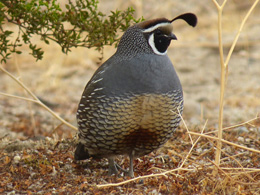 Huxley started his career studying marine invertebrates as an assistant surgeon on the HMS Rattlesnake, on a trip to Australia and New Guinea. He subsequently studied vertebrates, focusing on the similarities between apes and humans, before conducting the research that resulted in his conclusion that birds descended from small carnivorous dinosaurs. Huxley was also known as "Darwin's Bulldog" for his passionate defense of Charles Darwin's Theory of Evolution, and for coining the term "agnostic."
By the early 1900s, however, Huxley's theory fell into disfavor, and it took almost another 100 years for researchers to come back to the same conclusions, starting with the discovery of 22 features in dinosaur skeletons that occurred only in birds, and not in any other animals. Commonalities discovered now include feathers, once thought to be uniquely avian. Earlier this year, the American Museum of Natural History in New York determined that a pigeon-sized, four-winged 130 million year-old dinosaur fossil had iridescent black and blue feathers.
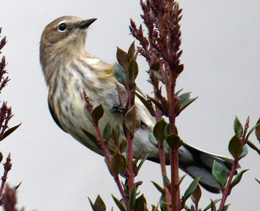 Feathers are the lightest, most efficient insulation ever discovered. They can keep a bird's internal temperature 140 degrees warmer than the outside air; store or repel water; allow for flight, and come in an amazing range of vibrant colors. Because feathers wear out, almost all birds lose their feathers during a molt and grow new feathers. Many birds, including species as diverse as hawks, woodpeckers, hummingbirds, jays, owls and swallows, molt once a year, replacing all their feathers.
Some of our most brightly colored birds, including tanagers, buntings and warblers, have a complete molt after nesting into drab plumage, and then a partial molt of body feathers into bright breeding plumage in the spring. One of our most common wintering birds, the Yellow-Rumped Warbler, is one of these. Commonly called butter-butts by birders, it's a bird that actually lives up to its name. In San Francisco, we see them by the hundreds in their drab winter plumage, but come spring, this little gray bird is transformed into an array of bright yellow, black, white and gray.
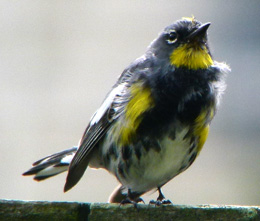 The Yellow-Rumped Warbler can be found almost anywhere in San Francisco in the winter, gleaning insects from trees, on the beach looking for insects in seaweed, or even in my backyard searching for food on a patio. By April, however, it's gone – headed for summer breeding grounds in the Sierras.
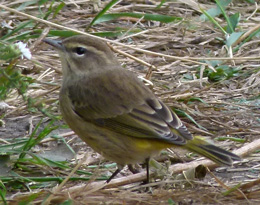 Unlike other warblers, the Yellow-Rumped can digest waxy berries, which allows them to winter as far north as Newfoundland (the eastern sub-species likes poison ivy berries).
The Palm Warbler is another warbler that is transformed after molting. A small number of these eastern warblers come through San Francisco in October and November, and some years one or two spend their winters here. When they arrive in the fall, they are mostly brown, with a little bit of yellow under their tails. Yet, in spring, they molt into a bright bird with a rufous cap and a bright yellow throat.
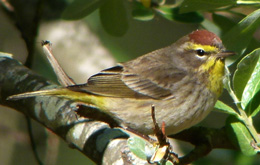 Despite their name, Palm Warblers spend their summers further north than most warblers, with a summer range that extends almost to the Arctic Circle. They have a habit of bobbing their tails, which makes them easy to identify.
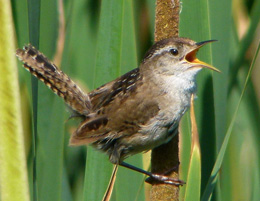 A few other bird species, mostly those that live in environments that produce great wear and tear on feathers, such as marshes with abrasive vegetation, have a complete molt twice a year. The diminutive Marsh Wren, found at Lake Merced, is one of those. Usually hidden in reeds most of the year, this vocal bird is easy to see in the spring, as males sing loudly from the tops of reeds, claiming their territory.
The male Marsh Wren is a very diligent nest builder. He'll construct up to 25 nests from grasses and sedges, and then escort his female mate from nest to nest until she chooses the best one to raise their offspring.
Molting can impair a bird's ability to fly, so many species lose just a few feathers at a time. However, since heavy-bodied birds with relatively short wings, such as waterfowl, quickly lose the ability to fly properly with the loss of even a few feathers, they lose all their feathers at once and are flightless for 3 to 4 weeks, instead of being partially impaired for an even longer period of time. Loons, grebes, ducks, swans and geese lose all their feathers, generally in early summer and again in fall, usually in wetlands where they can hide from predators. They hide in tall grass, or float on water until their feathers have grown back in.
Unlike most song birds, which have their bright plumage in spring and summer, most ducks get their brightest plumage in fall and winter, while they are looking for mates.
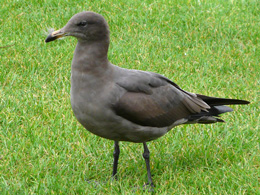 While many birds just molt from one plumage to another, gulls take it one step further. They can have different plumages in each of their first four years of life, usually starting with a dark brown plumage and ending up with a gray and white adult plumage. This makes gull identification extremely challenging, particularly for juvenile gulls, something I have not yet mastered.
The Heerman's Gull, for example, starts as a completely dark brown bird, with a pale bill and a dark head. By the time it reaches adult breeding age, it has a white head, a dark gray back and a bright red bill.
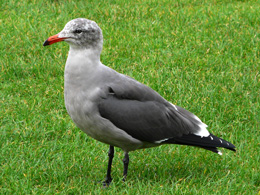 Heerman's Gulls are post-breeding migrants to San Francisco. Right now they are on their wintering grounds in northern Mexico, which is also where they raise their young. After the young are born, they head up the West Coast, as far north as British Columbia, reaching here in July. By late fall they start to head south again. Virtually all the world's Heerman's Gulls are born on one island in the Sea of Cortez in Mexico, Isla Rasa, so it was exciting news when they tried to raise young on Alcatraz Island in the late 1970s and early 1980s. Unfortunately, they were unsuccessful.
The Heerman's Gull, like many other gull species, steals food from other birds. This gull species is often seen stealing food from Brown Pelicans.
© All pictures were taken by David Assmann, Deputy Director of the San Francisco Department of the Environment. Do not reproduce pictures without permission.
Additional Resources
California Quail (National Park Service, Presidio of San Francisco)
Yellow-rumped Warbler (National Park Service, Presidio of San Francisco)