January 1, 2012
The word vagrant, generally associated with homelessness, has a negative connotation. But mention the word vagrant to a birder and it immediately conjures up images of exotic, often beautiful, lost birds. Every once in a while the innate sense of direction that migrating birds are born with gets out of alignment, and some birds end up thousands of miles from where they should be in fall and winter. These birds are known as vagrants.
Sometimes this results in tragedy. The many vagrants spotted on the Farallon Islands, for example, may very well end up dying in the Pacific Ocean if they continue to fly westward. Other vagrants, however, end up staying in San Francisco for days, weeks or months before they either fly on to their normal wintering destination, or fly back north or east in spring.
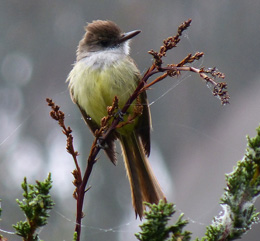
One of the most recent vagrants spotted in San Francisco is a Dusky-Capped Flycatcher – a Mexican bird that spends its summers near the Mexico-U.S. border, including in south-east Arizona. This nine-inch bird, with a brown cap and yellow belly, perches on trees and sallies out to catch insects. On December 29th, a Dusky-Capped Flycatcher was found on the Christmas bird count flying near the picnic benches across the street from Mallard Lake in Golden Gate Park.
Probably the rarest bird found on this year's count, it was found purely by accident. A team of birders stopped at these picnic benches for lunch, not expecting to find the rarest bird of the day next to a maintenance yard.
You can find vagrants in the most unexpected of places. Sue Bierman Park, across from the Ferry Building, is a tiny park (less than 2 square blocks) that attracts lost birds virtually every fall and winter. On November 13th, a Lucy's Warbler, a tiny warbler that summers in Arizona and New Mexico and winters in Mexico, showed up. This gray and white bird, the smallest warbler in North America, is the only warbler adapted to the desert, nesting in dead mesquite branches. It was amazing to see this desert warbler in an urban park surrounded by tall buildings on three sides.
This isn't the only unusual warbler in the park this winter. A beautiful Yellow-Throated Warbler has been seen regularly in the park since September 13th. This southeastern warbler normally spends its summers in pines and sycamores along rivers, and winters in south Florida and Mexico in palm trees. This year it seems perfectly content to forage in the poplar trees in Sue Bierman Park in downtown San Francisco, and has now been in the park for almost four months.
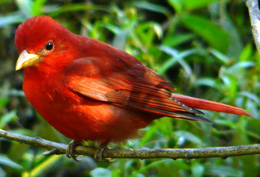
Most vagrants don't stay for months. The bright red Summer Tanager that took a liking to the cemetery in the Presidio in October stayed for less than ten days. A Cape May Warbler stayed for almost a week at Fort Mason in September. This bird is a nectar-eating warbler that usually spends its summers in Canada and winters in Cuba and other nearby islands. Alexander Wilson named this bird in 1811 after finding it in Cape May, New Jersey, not realizing at the time that Cape May was not the bird's normal home, either for the summer or winter. It wasn't seen again in Cape May for 100 years!
This past fall a number of beautiful eastern birds passed through San Francisco. At Fort Mason, a Blackpoll Warbler, a small warbler with yellow legs, spent 6 days near the community garden. This bird normally spends its summers in the boreal forests of Canada and then migrates south over the Atlantic Ocean to South America. Before it migrates, it doubles its body mass to prepare for the journey, which includes an average of 1,864 miles over water, which could be a non-stop flight of up to 88 hours.
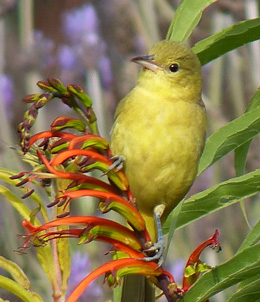
A couple of days after the Blackpoll left, a Chestnut-Sided Warbler, which also summers in Canada and spends winters in Central and South America, showed up for a few days.
Some vagrants, however, come back year after year, and may be on the verge of establishing a new wintering home. For seven of the past eight winters, there's been at least one wintering Orchard Oriole at the Fort Mason community garden. The smallest of the North American Orioles, it normally summers in the southeast and Midwest and spends its winters in Central and South America.
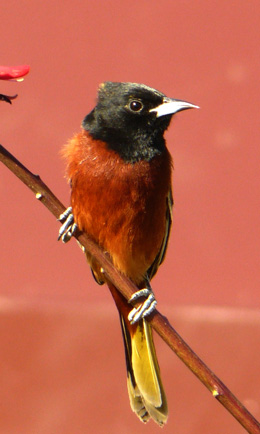
This year's wintering oriole is a bright yellow female bird. Male and female Orchard Orioles are so dissimilar they look like different species. While the female is mostly yellow-green, the male is a combination of brick red and black.
Lost wintering birds can fly enormous distances. For the past few winters there has been a Tufted Duck at Oakland's Lake Merritt. The Tufted Duck is a Eurasian duck, normally found from Europe through Siberia in the summer and from the Mediterranean to the Philippines in the winter. Yet, somehow every year a few decide to spend their winter in North America.
And for the past month, birders have flocked to the Sacramento Valley to see a Falcated Duck, which normally winters in India and Southeast Asia. This green, brown and gray duck nests in Russia, Korea, China and Mongolia. This bird is more than 7,000 miles away from its normal wintering habitat!
Unlike vagrants which come and disappear again, other birds come and stay, often because they were deliberately introduced by human beings to non-native habitat. The most infamous of these is probably Sturnus vulgaris – otherwise known as the European Starling if your Latin is rusty. In March of 1890, Eugene Schieffelin, a wealthy drug manufacturer, released between 60 and 80 of these English birds in Central Park as part of an effort to introduce all the birds mentioned in works by Shakespeare to North America. The following April, he released 40 more.
These 120 Starlings multiplied, and multiplied, and multiplied. Today there are between 200 and 300 million Starlings in North America, ranging from Alaska to Mexico – all descended from that original group of 120 birds. They can be seen in flocks of up to a million birds. While Starlings eat insects, they also eat agricultural crops, and through sheer numbers, can have a major impact on ecosystems.
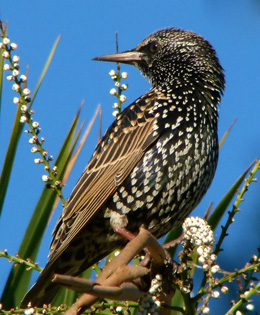
European Starlings are beautiful birds. In the fall and winter, their iridescent plumage can look surreal. They are the only local birds that whistle. They are also amazingly resilient. In 1964 Solano County, upset at crop damage by Starlings, decided to eradicate the species in the county. After three years nine million Starlings had been killed, but 5,000 still remained. To put that number in perspective, there were as many Starlings left in Solano County as there are Peregrine Falcons in the entire country today.
Forty years before the introduction of the European Starling in 1852, a group of House Sparrows, native to England, were released in a Brooklyn cemetery. Not only did these birds spread across the country, but they were subsequently able to expand to Canada, Cuba, South Africa, South America, Hawaii, Australia, and New Zealand.
© All pictures were taken by David Assmann, Former Deputy Director of the San Francisco Department of the Environment. Do not reproduce pictures without permission.