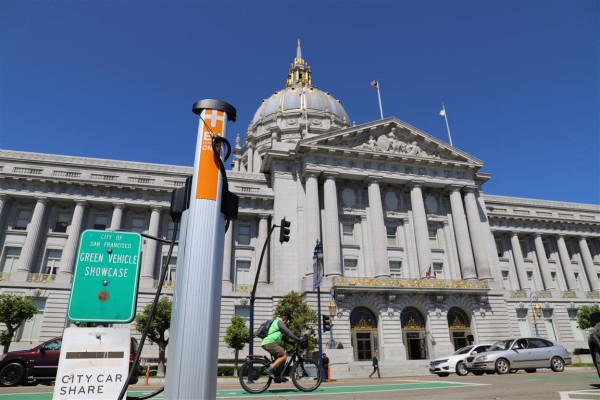
This resource page provides guidance and tools to support setting up publicly accessible electric vehicle (EV) charging in the City and County San Francisco.
San Francisco’s public charging goals
San Francisco aims to have 25% of all registered private light-duty vehicles (cars and small trucks) electrified by 2030 and 100% by 2040.
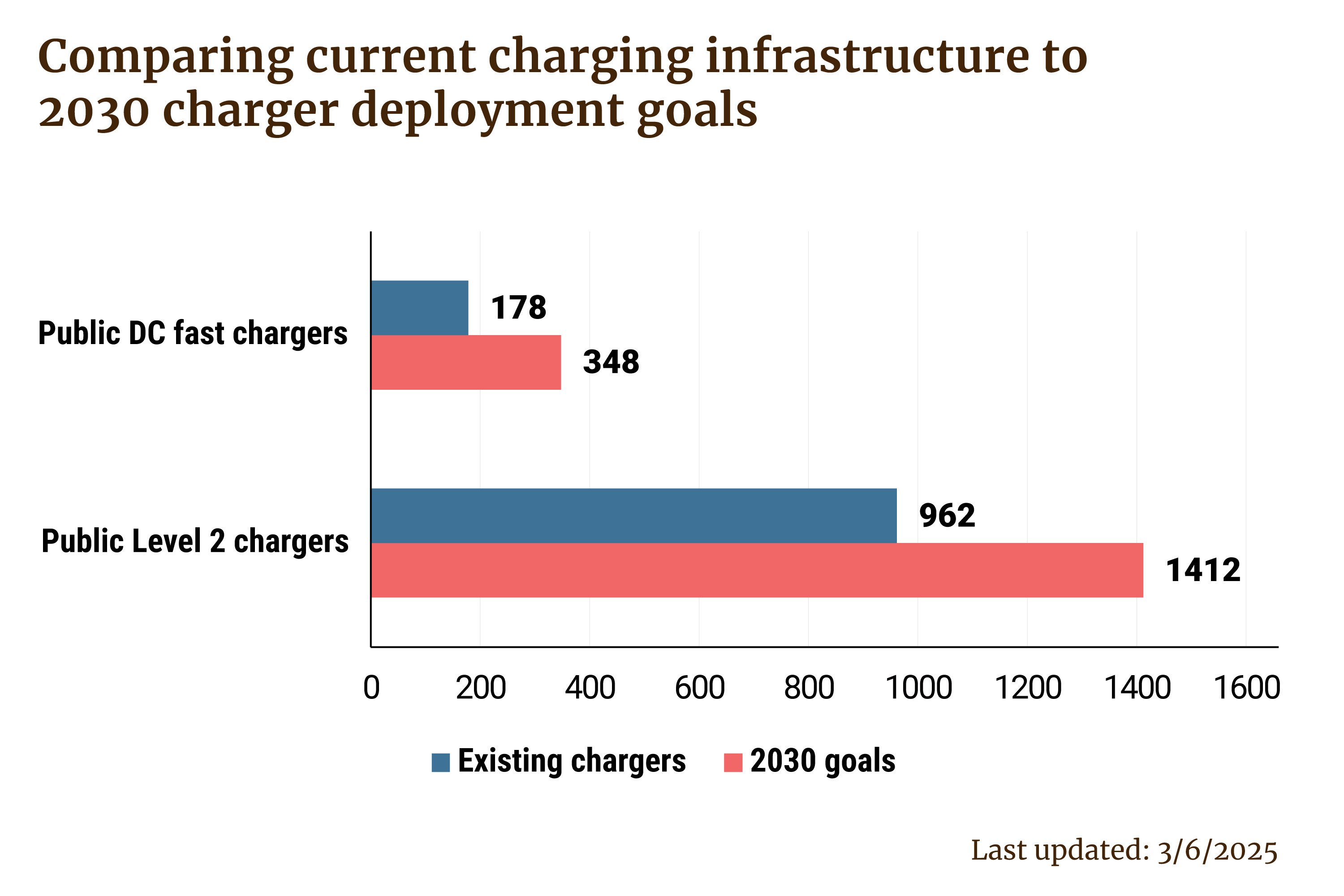
As the adoption of EVs continues to rise, having a reliable network of charging stations is crucial. San Francisco estimates needing 1,760 public chargers to meet expected 2030 charging demand – 1,412 Level 2 chargers and 348 DC fast chargers.
Know the process to set up public EV charging
The guide below walks you through the essential steps for planning public EV charging infrastructure, or electric vehicle supply equipment (EVSE), projects. Note that many steps may be executed in parallel rather than sequentially.
Are you new to EV charging? Review Veloz’s EV charging basics to gain a better understanding of the technology!
Project development and scoping
Establish overall project scale
- Define the project’s scope, budget, timeline, and funding options, and prepare to be flexible as costs and other factors evolve.
- Assess current and future EV charging demand and review charger types and costs. Learn more about charger types and speeds.
- Explore available funding and financing opportunities. Learn about current incentives for chargers and vehicles, utility savings, and carpool lane decals.
Determine site and installation type
- Identify your target users (e.g., public, fleets, customers, multi-family housing residents, employees, etc.) and explore different location types (e.g., retail, hotels, community center, parking garages, curbside, etc.)
- Consider potential priority sites in San Francisco using UC Berkeley’s EV Equity Roadmap mapping tool (still under development) to look at site selection factors such as potential EV demand, equity priority metrics, and utility capacity. SF Environment plans to leverage the tool when engaging with industry and the community to prioritize future sites for public charging.
- Consider technical, economic, and regulatory factors that can impact the installation and use of the charging stations (e.g., proximity to amenities, accessibility, electrical capacity and equipment location, and future proofing for scaling and/or multimodal uses).
Identify and connect with project partners
- Connect with project partners early to identify key components and potential constraints to ensure the project is successful. Partners include site hosts, local utilities (in San Francisco, Pacific Gas & Electric and the San Francisco Public Utilities Commission – see the “Utility planning” section for information), and City agencies such as San Francisco Environment Department and the Department of Building Inspection.
- Contact [email protected] to connect with our EV Ombudsperson on project barriers, questions, and technical support.
Decide on an ownership model
- Either the site host or a third party, such as a charging network company, can own, operate, and/or maintain the EVSE.
- Depending on the ownership model, a charging network company may enter into lease, revenue sharing, network, and/or operations & maintenance agreements with the site host.
Assess charging needs
To determine the number and types of chargers needed, it is important to assess:
- The expected total demand for charging (e.g., number of vehicles per day, types of vehicles). Does the expected demand support the overall business case for the installation?
- The expected demand profile. Will demand be steady throughout the day, or will there be peaks in demand at certain times of day?
Permitting and regulatory compliance
- Identify regulatory needs and necessary permits to set your project up for success!
- Review all local regulations and permit requirements. See below for more information on regulatory compliance in the City and County of San Francisco.
- Be aware of any funding requirements if you are receiving federal, state, or local funding (e.g., Buy America provisions, Open Charge Point Protocol (OCPP) compliance, etc.).
- Plan for accessibility and ensure your site is ADA-compliant.
- Observe Tribal laws and requirements when building on Tribal Lands.
Utility planning
Two utilities operate in San Francisco: Pacific Gas & Electric (PG&E) and the San Francisco Public Utilities Commission (SFPUC).
Assess local grid infrastructure
- Connect with PG&E and/or SFPUC to assess the existing power supply and determine if there is sufficient capacity to support your new charging project, identify required electrical upgrades, and discuss future proofing the site.
Determine electricity rates and pricing structures
- Coordinate with utilities to understand electricity pricing, demand charges, and time-of-use or other rate schedule options. This may have an impact on the financial viability of the project.
Installation planning
Determine equipment network needs
- Decide whether the charger station will be networked (connected via Wi-Fi or ethernet) or non-networked (no internet connection needed).
- Networked stations can enable specific payment methods for consumers (e.g., via smartphone, credit card, attendant/nearby establishment), remote monitoring and updates to charging stations, and data collection.
Select equipment and network provider
- Compare available equipment and network providers on the market to make your final selection using CALeVIP’s Find EV Charging Providers tool.
Estimate installation costs
- Determine the total cost of installation for your preferred charger types, including the costs of trenching and any required electrical upgrades.
Operations and maintenance
Assess operational needs and costs
- Determine pricing model (e.g., kWh-based, time-based) and payment systems (e.g., mobile app, RFID, credit card) for users.
- Consider additional factors such as security, lighting on site, signage, and availability on EVSE search tools (e.g., Alternative Fuels Data Center’s Station Locator).
Consider maintenance needs and costs
- Decide on a system or services contract option for routine inspections, software updates, and prompt repairs to charging stations on the site.
- Consider options to protect EVSE from vandalism and theft.
Want to know more about the process? See the resources below :
- EV Infrastructure Project Planning Checklist – Checklist from the U.S. Department of Transportation that has more details on each of the steps mentioned above.
- California EV Charging Station Permitting Guidebook – Planning guide from the California Governor’s Office of Business and Economic Development with information on each step of the planning process.
- Public EV Charging Infrastructure Playbook – Training modules and planning templates from the U.S. Joint Office of Energy and Transportation to help plan your EV charging project.
Learn about San Francisco’s charging requirements
Review all local policies and requirements before starting your public charging project.
- Review local permitting requirements – Use the San Francisco EV Charger Permitting Checklist to identify permitting requirements for your project.
- Be aware of local fire safety rules – Plan review by San Francisco Fire Department is required for installation of new DC fast chargers in enclosed off-street parking areas. Review San Francisco Fire Department Administrative Bulletin 4.29 for full requirements.
- Follow EV readiness requirements – San Francisco EV Readiness Code requirements apply to residential and commercial new construction buildings and existing buildings with major alterations.
- Meet all local zoning requirements – San Francisco's Planning Code establishes requirements for the location, design, and accessibility of EV charging stations across different zoning districts, including specific rules for an EV Charging Location and Fleet Charging uses.
- Learn about EV charging requirements for commercial garages – The Commercial Garage EV Charging Ordinance requires commercial parking garages and lots with more than 100 parking spaces to install EV chargers.
Existing public charging
View the map below to see where public EV chargers are currently available in San Francisco County.
Visit the San Francisco Clean Cities Coalition’s EV Dashboard for an interactive map where you can see station addresses, charger types, and more.

Last updated: 4/3/2025
Get involved
- Get support – Contact [email protected] to connect with our EV Ombudsperson on project barriers, questions, and technical support.
- Partner with us – Sign up to receive notices for future public/private partnership opportunities with San Francisco.
Additional resources
- Charger Incentives – Review available incentives for chargers and EVs.
- San Francisco Land Use Map – Explore land uses to site your project using this mapping tool from the City and County of San Francisco.
- EV Equity Roadmap mapping tool (still under development) – Consider potential priority sites in San Francisco using UC Berkeley’s mapping tool to look at site selection factors such as potential EV demand, equity priority metrics, and utility capacity.
- Charging Provider Search Tool – Find a qualified service provider to help you complete your projects using CALeVIP’s search tool.