Get free assistance for your business in San Francisco to comply with the City’s Zero Waste policies.

How to comply:
Follow these five steps to comply with the Mandatory Recycling and Composting Ordinance passed by the City and County of San Francisco in 2009.
Step 1: Assess and get adequate refuse collection services
- Adequate refuse service is when there is enough capacity for all the recyclable, compostable, and trash material generated at all times.
- Use Recology’s on-site refuse assessment form to assess each refuse stream: recycling, compost, and trash. Familiarize yourself with your business’ refuse streams to determine opportunities for waste reduction.
- Determine if your business needs to change the size of the refuse bins and/or frequency of pickups per week. Contact Recology at (415) 330-1300 or [email protected] for assistance on right-sizing your business’ service.
- Explore sustainable options that could prevent or minimize waste. Implement environmental purchasing policies such as buying in bulk or reusable and durable items as opposed to single-use or disposable to help reduce the amount of waste your business generates.
Step 2: Set up indoor bins efficiently
Convenience is key
- Keep indoor recycling, compost, and trash containers together so that it is equally convenient to dispose of all three streams.
- Use color-coded bins
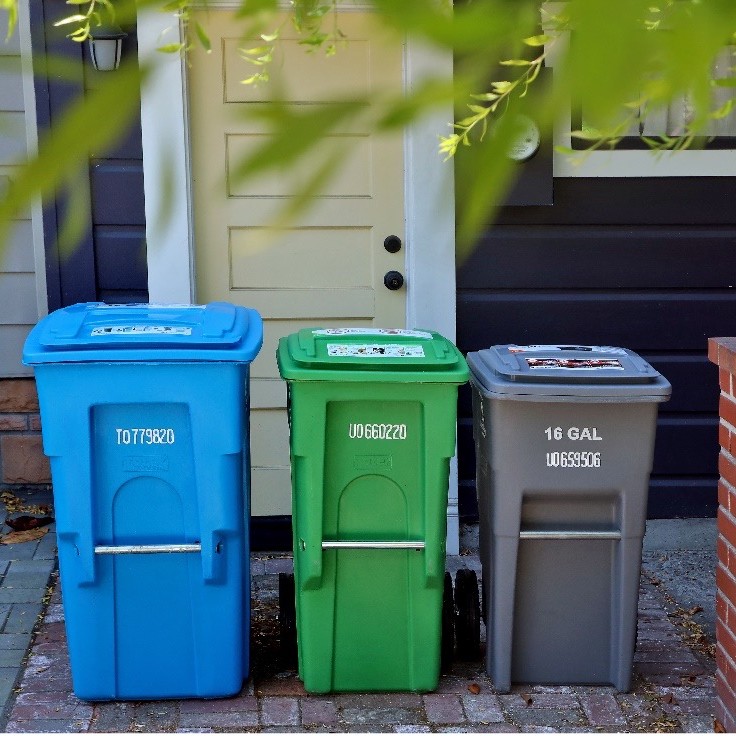
- Use green for compost, blue for recycling, and black or gray for trash.
- For restrooms, it is recommended to only have a compost bin labeled “Paper towels only”.
- Select the appropriate liners for the containers.
- For compost bins, use BPI certified compostable plastics bags or paper bags for compost collection. Visit www.bpiworld.org for a list of certified products.
- All recyclables must be loose, dry, and clean in the blue Recology collection container. The property may use clear plastic bags or paper bags to capture recyclables generated inside the business.
- If the property is using clear plastic bag liners, then all recyclables must be placed into the blue bin and the plastic liner disposed of in the trash. No plastic liners are accepted in the blue recycling containers.
Signage and Stickers
- Properly label centralized refuse stations.
- Download signage and/or customize your own.
- For stickers, contact Recology at (415) 330-1300 or [email protected]
Step 3: Source-separate materials into proper bins
- Source-separate means to divide refuse at the place of generation, prior to collection into separate containers that are designated for recyclables, compostables, or trash.
- Learn how to compost and recycle on SFRecycles.org.
- Save money on your Recology bill by recovering all possible material to recycling and compost from the landfill. Customers are charged more when they dispose refuse in the landfill stream. Contact Recology at (415) 330-1300 or [email protected] for more information on how your property can achieve a diversion discount.
Step 4: Educate and monitor
- Communicate best practices to keep all three streams clean source-separation to your stakeholders - employees, tenants, custodians, and patrons at least annually.
- Examples include:
- Send an email to all stakeholders about items that are most commonly not sorted properly.
- Highlight stakeholders that are doing well in their refuse separation.
- Schedule a training led by Recology Waste Zero Specialists on how to separate refuse that is specific to the workplace. Contact Recology at (415) 330-1300 or [email protected]
- Remind your stakeholders that e-waste, hazardous waste, and other toxic products do not belong in the recycling, composting, or trash streams.
- Examples include:
- Conduct internal audits to identify areas of improvement.
- Regularly check bins to ensure materials are sorted correctly and provide feedback.
- Ask custodial staff for feedback on issues that they see coming up.
- Consider hiring a Zero Waste Facilitator or a consultant to help with service monitoring, educational training, or on-site sorting.
Step 5: Annual reminder of requirements
- Each property in San Francisco is required to communicate source-separation requirements and provide resources every year to their stakeholders.
- Inspect bins to ensure the signage is up-to-date and that bins are placed in convenient locations.
- Educate stakeholders on:
- New initiatives the property is taking to advance zero waste
- Best practices for source-separation
Additional support
The Environment Department strives to educate and assist. Please complete the SF Zero Waste policies compliance form to sign up to receive extra assistance or a reminder of the requirements.
Available grants
SF Environment offers grants for businesses and properties looking to be on the forefront of sustainability. Browse and click the links below to learn more details:
Compliance consultations
Contact SF Environment to schedule a site visit, request resources, or receive more information about policies and programs.
Additional resources and information
Visit these links for more background on Zero Waste compliance.
- Mandatory Recycling and Composting Ordinance
- Mandatory Recycling and Composting Ordinance FAQ
- Recycling and Composting Requirements for Businesses
- Zero Waste for Restaurants and Cafes
- Striving for Zero Waste
- Recology’s on-site refuse assessment
- Refuse Separation Compliance Ordinance
- How to compost and recycle
- Save money on your Recology bill
- Refuse Rates
- SF Zero Waste policies compliance form